

Nebuchadnezzar was almost as fearsome as the spelling of his name. He walked the earth over 2,500 years ago and ruled over a mighty kingdom. But his encounter with an even mightier kingdom and its king, literally brought him to his knees. The true story is captured in Nebuchadnezzar’s own words in the Bible itself. The gripping tale explains to all who have always wondered, “What does it mean to fear the Lord?’”
Where Man Learned to Conquer
The ancient middle east hosted the world’s earliest civilizations. It was here that man first came up with the idea of how to build cities in an area now known as the Fertile Crescent. But this location also became the birthplace of a more cruel discovery: the empire. It didn’t take long for people to see the cities that began emerging around them and desire to have those cities for themselves. The first emperors were those who honed the terrible skills of how to bring those greedy desires into reality.
Babylon ranks high on the list of cities known to have mastered this skill. It rose and fell, conquered and was conquered numerous times in the early ages of civilization. But it was Nebuchadnezzar who stretched the war-making arms of this city to its greatest length.
A Developed Skill for Large Scale Theft and Enslavement
Nebuchadnezzar made his name as a military man who spent much of his reign on campaign. He led his armies from city to city and from nation to nation, taking all that he saw. But where he truly excelled was not in taking cities, but in developing an efficient system of large scale theft and enslavement. He went to those far off places not to wreak havoc, but to entice the population into sending gold, treasure, and slaves back to his city.
Infamously, one of those pillaged peoples were the people of Judah, the southern kingdom of Israel; and one of those slaves, the prophet Daniel. It is in the writings of Daniel that we see how Nebuchadnezzar learned there were more terrifying sounds than the rumble of his chariots.
A Voice from Heaven Humbles the Great Emperor
In the fourth chapter of Daniel, there is an odd occurrence. The prophet Daniel turns over his writing utensil to the king of the Babylonians. Verse one reads, “I, King Nebuchadnezzar, am writing this letter,” revealing that now we are hearing the very words of this fearsome king.
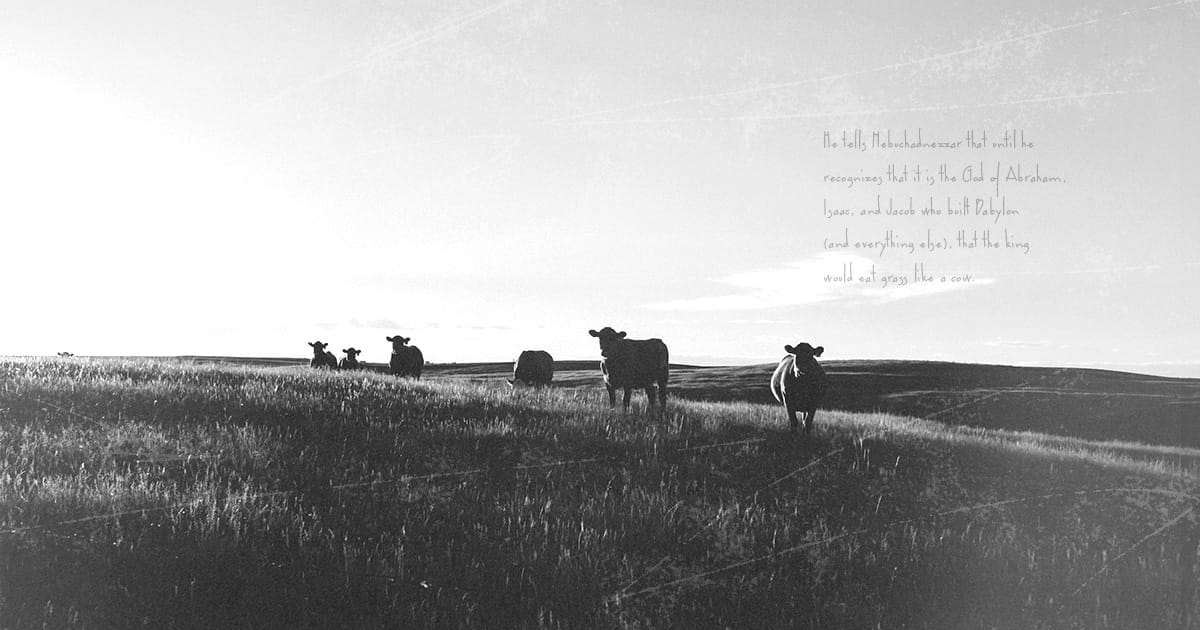
The story begins with Nebuchadnezzar looking over his kingdom and boasting of what he built. But God, who built all, hears this prideful claim and commits himself to humbling the emperor. He tells Nebuchadnezzar that until he recognizes that it is the God of Abraham, Isaac, and Jacob who built Babylon (and everything else), that the king would eat grass like a cow.
Instantly, the mighty emperor transformed into a madman. He left the palaces funded by the gold and riches of his conquerings and he settled into a cow pasture. He abandoned the gluttonous feasts of his table for grass and wild plants. His appearance morphed from that of an absolute monarch to an absolute embarrassment. His fingernails grew out like claws. His clothes became stained and worn.
Finally, he looked to heaven and cried out, “Glory to God.”
The Meaning of Fear
Nebuchadnezzar mastered the art of fear. With his armies behind him, he convinced millions of people to turn over their gold and their freedom. But the God of heaven and earth taught him that it is He who must truly be feared.
Many wonder why the Bible says so often, “Fear the Lord.” It seems a strange command when the Bible is also so insistent on the love and kindness of this same God. But it’s stories like this that reveal that love and fear can and should coexist when dealing with the Divine.
God is love, meaning love is God’s primary and most prominent attribute. But he is also unimaginably powerful. He spoke the universe into existence. He holds together all of creation with his breath. To humble a mighty emperor is the smallest of his achievements. Love allows such things as punishment and correction. Nebuchadnezzar learned this firsthand.
So should you love God? Absolutely! It is our highest command, reiterated by Jesus himself. But we should also fear him. He is kind and yet also terrifyingly powerful. He is good and still unimaginably huge. He can transform even the mightiest king into a grass-eating madman with just a word.
He is mighty. And fear is a proper response to that power.